

Semrush: Most websites perform poorly in mobile view
Well-known SEO analyst firm has looked at data from tens of thousands of U.S. sites, as Google promises to soon base its rankings on Core Web Vitals (CWV) metrics as well.
Semrush published its comprehensive study in April, examining the performance of roughly 78,000 URLs in desktop view and the same in mobile view. For the study, 10,000 keywords collected from our own database were searched on Google’s search engine, and evaluations of the top 10 ranked URLs were collected. The keywords were chosen at random, meaning they included terms of all kinds of themes, lengths, and popularity.
The reason for the research is to be found in a long-awaited update by the search engine power, and according to recent reports, which is already quite imminent. While it is not yet known how much this will change the current search results for organic results on the Search Engine Results Page (SERPs), Google has repeatedly stated in its official communications that it will be essential in the future. will attribute to Core Web Vitals values.
What metrics does Core Web Vitals consist of?

LCP (Largest Contentful Paint): Shows the time it takes for the largest image or block of text on a page to load, that is, when the user sees a properly usable page in the browser. FID (First Input Delay): the time required to respond to a request (eg click a link, press a button). The research Semrush in a similar metrics, the TBT t (Total Blocking Time - Full time blocking) measured as the "lab" type of measurement is more appropriate . CLS


 (Cumulative Layout Shift): Describes the phenomenon where some elements that load later on the page shift the rest of the content.
The main findings of the study:
- Each URL on a website may receive different ratings in mobile and desktop views.
- There are many areas and factors to consider when optimizing a particular website.
- In mobile view, more URLs get a “Poor” rating than in desktop view. (For a “poor” rating, it is sufficient that one of the 3 main factors does not hit the bar.)
- Likewise, the highest “Good” rating received far more desktop URLs than their mobile counterparts.
- The vast majority of URLs that are rated “Good” are already in a good position on the SERP pages.
- Of the three metrics, websites rank best for the highest visual content response (LCP).
- Improving Core Web Vitals metrics is likely to be the most effective way to optimize for search after the update is introduced - as current trends seem to attest.
The vast majority of mobile URLs fall far short of expectations
One of the key findings of the research is that most of the URLs examined perform much worse on average in mobile view. To show the exact proportions:
- nearly 84% of them rated CWV as “Poor” or “Needs Improvement” on their mobile in general (14.5% “Needs Improvement” and 69.3% “Poor”);
- the proportion of URLs with a value of “Needs Improvement” but other “Good” in the desktop version is 22.9%, but only 14.5% in the mobile version;
- however, those with a rating of “Poor” in all three indicators account for only 1.3% on desktop and 7.8% on mobile.
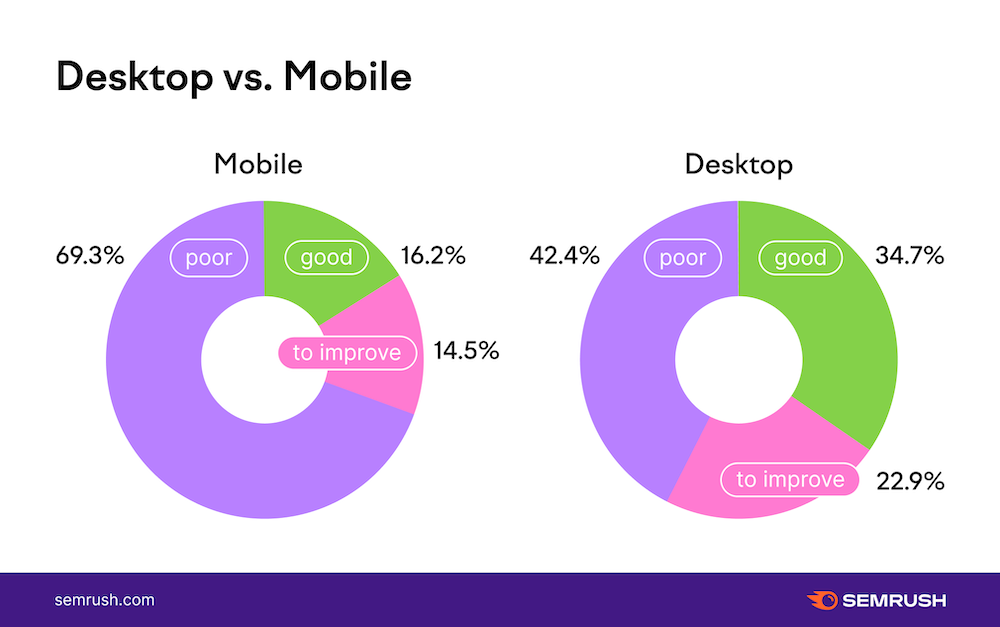
This can also be a concern for many because the company has been emphasizing for several years now that the “mobile first” approach must be followed because smartphones have become essential - most web development companies already design pages for mobile. If, on the other hand, this is indeed to be such an important consideration in the forthcoming update, major changes in the SERP position will be expected.
The full study is freely available on the Semrush website


